Alexandra Duarte’s Mail Promises Affordable Groceries by “Securing Water for Farms.” As President of an East-Side Growers’ Group, She Fought Cuts to Their Groundwater and Took Aim at Cities’ Share.
Letters Duarte signed in August 2025 and January 2026 objected to a plan cutting groundwater pumping by farms east of Modesto by about two-thirds, called it “discriminatory,” and argued cities get a “double dip.”
Alexandra Duarte’s campaign mail promises to make life affordable. One mailer says she will lower the cost of groceries “by securing water for farms.”
As recently as January 2026, five months before the primary, Duarte led a group of east-side growers in a fight over exactly that: how much groundwater farms outside the local irrigation districts may pump. As president of the Stanislaus East Mutual Water Company, she signed letters to the local groundwater agency in August 2025 and January 2026. They objected to a plan, required under state groundwater law, that would cut pumping by those growers by about two-thirds, called the plan “discriminatory and economically destructive,” and argued that cities, including Modesto, receive a “double dip” of groundwater. The August letter also proposed paying for more urban surface-water use in part by “marketing of groundwater extraction rights to NDE growers.”

The groundwater plan
Under California’s Sustainable Groundwater Management Act, local agencies must stop the long-term overpumping of their aquifers. In January 2024, the state Department of Water Resources told the agencies managing the Modesto groundwater basin that they needed a stronger plan to “stop the overdraft that is continuing to occur in the Subbasin.”
The local response is a Groundwater Use Management Program, dated January 28, 2026. It divides the basin into four areas and sets how much each may pump. One area, the Non-District East, is the farmland east of Modesto that lies outside the Modesto and Oakdale irrigation districts and relies almost entirely on wells. According to the program, the area has historically pumped about 89,700 acre-feet of groundwater a year. Its base allocation is 30,100 acre-feet, 34% of that amount. A temporary transfer of surplus from the Oakdale Irrigation District raises it to 40,800 acre-feet, still a cut of 48,900 acre-feet, or 55%.
The program says the Non-District East will start in its second response level, which requires an action plan by Nov. 1, 2026, and pumping reductions starting in 2027. It says the Modesto management area, after accounting for redistributed water, “is in balance.” The program caps the cities’ combined groundwater use, about 35,000 acre-feet a year for Modesto, Oakdale, Riverbank and Waterford, at their historical levels.
The Stanislaus East Mutual Water Company represents part of that area. It is a member-owned company whose stated purpose, in its 2024 federal tax return, is “to procure water supplies for the benefit of its members.” That return lists Duarte as a director; by August 2025 she was signing letters as its president. In a January 2025 presentation to a Stanislaus County advisory committee, the company’s general manager said its members farm 11,000 irrigated acres of the area’s 38,000.
The August 2025 letter
On Aug. 8, 2025, Duarte wrote to the board of the Stanislaus and Tuolumne Rivers Groundwater Basin Association “on behalf of the Non-District East (NDE) area stakeholders.” The letter, signed “Alexandra Duarte, President, Stanislaus East Mutual Water Company,” urged the agency to prioritize projects that “can reduce the scale of demand management needed,” meaning the pumping cuts.
Several of those projects involved cities. The letter said Modesto’s surface water treatment plant runs at about half its capacity “while the city continues to draw approximately 20,000 acre-feet of groundwater annually,” and called for a plan “to expand surface water use city-wide.” It said the plant could also serve Waterford, Oakdale, Salida and Riverbank. “For funding,” it said, “federal, state and local monies can be combined with marketing of groundwater extraction rights to NDE growers.”
The letter did not estimate what treated river water would cost those cities, which rely on wells, and suggested that well treatment and maintenance costs would be “likely significant cost offsets.” Nearby cities that have made the switch paid more. When Turlock and Ceres joined to build a plant to treat Tuolumne River water, Turlock’s single-family water bills were set to rise 205% over five years, the Turlock Journal reported, and Ceres approved increases of 40% and then 37% to pay its share, the Ceres Courier reported.
Attached was a technical review by EKI Environment & Water, a consulting firm working for the water company. It said the draft plan “assigns nearly all reductions to NDE.” It also argued that municipal areas receive a “duplicate allocation” that “provides municipal areas with a greater share of the Basin’s estimated sustainable yield than any other group,” and recommended removing city acreage from part of the calculation. EKI said that change “would not affect municipal access to groundwater.”
The January 2026 letter
On Jan. 27, 2026, the water company sent a second letter, signed “Alexandra Duarte, President,” after the final draft of the program was released. It called the program “a fatal misapplication” of the groundwater law that “imposes a discriminatory and economically destructive reduction mandate” on the Non-District East and called the required cut “a punitive 66% reduction.” It accused the agency of violating the state’s open-meetings law and demanded several changes, including that the agency “Correct the Municipal Double Dip.” It closed: “Failure to address these issues will leave us with no choice but to seek all available legal and administrative remedies.”
What it means for cities
Modesto already plans to rely more on treated river water. Its draft 2025 urban water management plan, prepared with the Modesto Irrigation District, says the city “plans to gradually increase the use of treated surface water supply from MID” and assumes surface water could meet up to 70% of its demand in normal and wet years. From 2021 through 2025, surface water averaged 52% of the city’s supply. The city buys that water from the irrigation district under a long-term agreement.
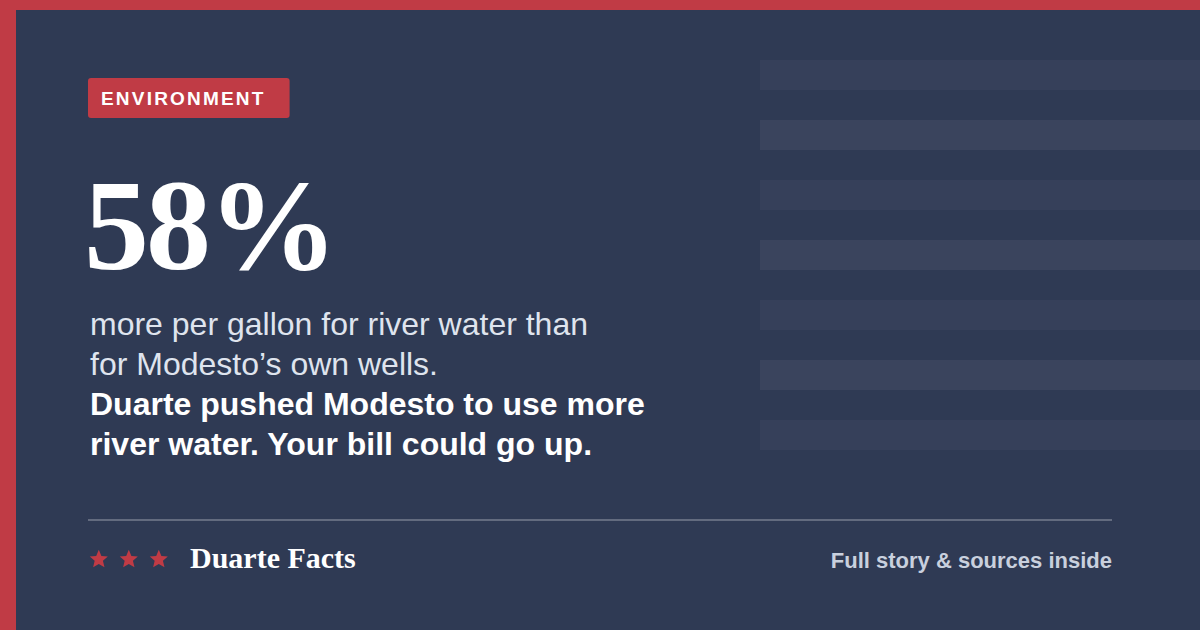
The city’s own budget figures show what that river water costs. From 2020 through 2025, Modesto paid the irrigation district an average of about $527 for each acre-foot of treated river water it bought, not counting payments on the treatment plant’s debt, which the city owes no matter how much water it takes. Running its own wells cost about $334 an acre-foot. By that measure, river water cost the city about 1.6 times as much as groundwater. Counting the debt payments, the average was about $891 an acre-foot, 2.7 times the cost of well water.
| Year | River water from MID | City wells | Ratio |
|---|---|---|---|
| 2020 | $467 | $258 | 1.8× |
| 2021 | $396 | $324 | 1.2× |
| 2022 | $489 | $284 | 1.7× |
| 2023 | $581 | $343 | 1.7× |
| 2024 | $572 | $383 | 1.5× |
| 2025 | $659 | $445 | 1.5× |
| 2020–2025 (average) | $527 | $334 | 1.6× |
These are averages, not a forecast. Water bills also pay for pipes, staff and other costs; the city’s well budget may not capture every cost of pumping; and extra water from a plant running below capacity could cost more or less than the average. The figures do not show how much any customer’s bill would change. They do show that the source Duarte urged Modesto to use more of has cost the city more per acre-foot than the wells it would replace, and the city’s costs are paid by its ratepayers.
Duarte’s letters did not ask Modesto residents to pay more for water, and they framed the proposals as good for the whole basin. But the August letter proposed that groundwater rights could be marketed to the growers she represented as part of paying for cities to use more river water, and both letters asked the agency to shrink the share of the allocation credited to city land. Neither letter says how any added cost to city water customers would be covered beyond the funding sources it lists.
On the campaign trail, her mail describes her water agenda in one line: “securing water for farms.”
Alexandra Duarte, a Republican, is running for California State Senate District 4 on the Nov. 3, 2026, ballot. She is married to former Rep. John Duarte, who has served as president of Duarte Nursery.
Sources
- Stanislaus East Mutual Water Company, Alexandra Duarte, president, letter to the STRGBA Board, “A Path Forward for Sustainable Groundwater in the Modesto Subbasin” (Aug. 8, 2025), with attached EKI Environment & Water technical evaluation (July 28, 2025)(opens in new tab)
- Stanislaus East Mutual Water Company, Alexandra Duarte, president, “Comment Letter – Final Draft Groundwater Use Management Program” (Jan. 27, 2026)(opens in new tab)
- STRGBA GSA and Woodard & Curran, Modesto Subbasin Groundwater Use Management Program (Jan. 28, 2026), Tables 3–5 and Sections 2.1.2.3 and 4(opens in new tab)
- City of Modesto and Modesto Irrigation District, Public Draft 2025 Joint Urban Water Management Plan (May 2026)(opens in new tab)
- Stanislaus East Mutual Water Company, IRS Form 990-EZ for 2024 (Part III purpose; Part IV officers and directors)(opens in new tab)
- Turlock Journal, “Council adopts water rate increases”(opens in new tab)
- Ceres Courier, “City leaders acknowledge rate hike ‘painful’”(opens in new tab)
- Stanislaus East Mutual Water Company overview, presented to the Stanislaus County Water Advisory Committee (Jan. 29, 2025)(opens in new tab)
- Duarte for Senate 2026 mailer, “Alexandra Duarte has a plan to make life affordable.” Photograph submitted to Duarte Facts.
- City of Modesto, adopted budgets, 2020–2025 (water fund accounts 45070, MID operations; 55140, MID bond debt; 45050, Wells & Tanks); acre-feet from the Public Draft 2025 Joint Urban Water Management Plan. Per-acre-foot costs calculated by Duarte Facts.(opens in new tab)
Lawsuit allegations are claims, not findings, unless a court ruled. See something wrong? How to request a correction.
Read more: Alexandra Duarte for Senate: the full record
More from the record
The Company That Bought 1,500 Acres From Duarte Nursery Paid $5.3 Million Over Wetlands. Its Lawsuit Says the Nursery Didn’t Disclose the Land’s Environmental Restrictions.
The federal penalties were for Goose Pond Ag’s own work on the land. Its 2019 lawsuit against Duarte Nursery makes allegations, not court findings, and we have not confirmed how the case ended.
A Federal Judge Ruled Duarte Nursery Broke the Clean Water Act by Tearing Up Protected Wetlands. It Paid $1.1 Million to Settle.
The Justice Department says the company’s own consultant had warned that ripping the land without a permit could bring significant penalties. In a 2017 TV interview about the Army Corps of Engineers’ case against him, John Duarte said: “These guys are a carload of idiots and they’re evil.”
Who’s Paying for Alexandra Duarte’s Campaign? Start With Big Tobacco.
Philip Morris USA, the maker of Marlboro, gave Duarte the $5,900 maximum while a vaping bill its lobbyists worked on was pending. Nine donors with records of misconduct or a stake in what Sacramento decides have given her campaign $45,400.