More Than 20 Growers Have Sued Duarte Nursery Since 2015. When Its Trees Failed, the Nursery Fought Them With Its Fine Print.
Farmers who planted Duarte Nursery trees say they lost orchards, harvests and millions of dollars. In court, the nursery pointed to fine print capping what it owed. A judge found that growers who asked for refunds “were left with no remedy at all.”
Alexandra Duarte tells voters she is “a farmer, a mom, and one of us.” Her family’s business, Duarte Nursery in Hughson, sells trees and vines to farmers across California. Since 2015, farmers who bought those trees have sued it again and again.
Pistachio growers say thousands of trees they planted turned out to be defective. An avocado grower says DNA tests showed he got a different kind of tree than the one he paid for. A lemon grower says he was sold the wrong variety and harvested it for five seasons before he found out. Each case came down to the same question: when a nursery’s trees fail, who pays for the lost crops? And in each, Duarte Nursery leaned on the fine print on the back of its standard contract. That fine print says the nursery makes no promise the trees will be fit for their purpose, and it caps what a farmer can collect at the price of the trees, however much the farmer loses.
The nursery denied the growers’ claims. In the biggest case, a judge threw out that fine print as “unconscionable and, therefore, unenforceable,” the legal term for contract terms so one-sided that a court won’t enforce them. He also found that growers who asked for their money back “were left with no remedy at all.” Three years later, the nursery relied on the same clause against the lemon grower. The nursery’s side of each case is in the response section below.
Case 1 · Pistachios · 2015–2025
Pistachio growers: thousands of failed trees
Planting a pistachio orchard is a long bet. A farmer buys young trees, plants them and waits years for a crop. One grower’s damages estimate in this case assumed a small first harvest in the orchard’s sixth year and a much bigger one in its seventh, with yields still climbing after that. University of California economists plan on a pistachio orchard producing for 40 years.
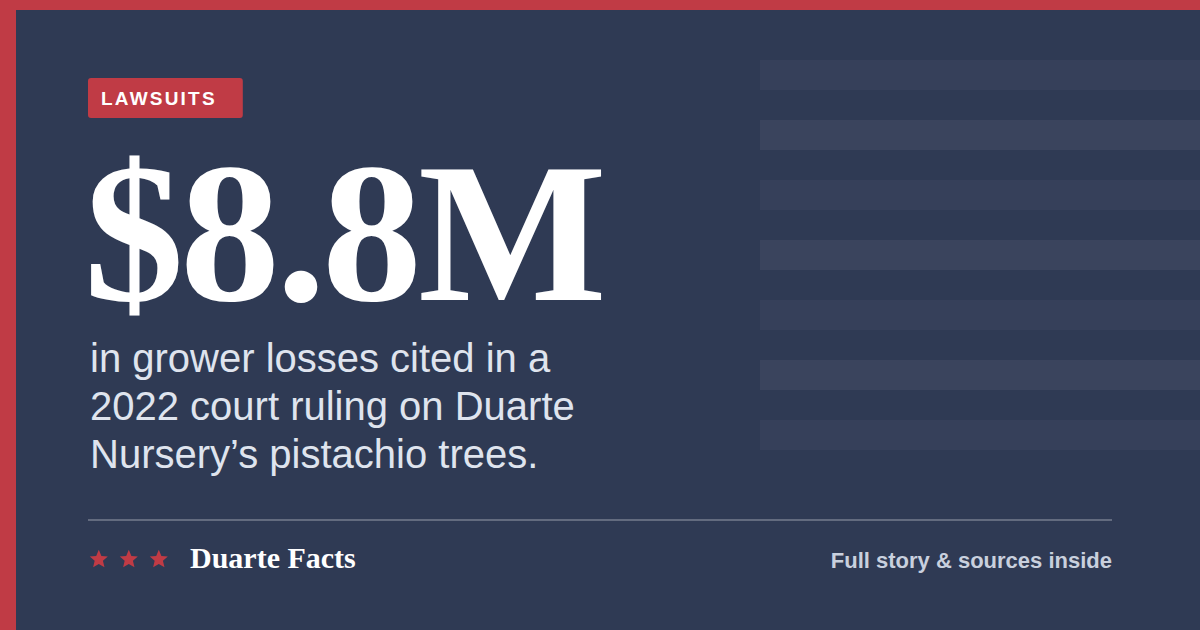
Much of that bet rides on the rootstock: the roots and lower trunk onto which the nut-bearing branches are grafted. Between 2011 and 2014, many of the rootstock trees Duarte Nursery sold to pistachio growers turned out to be defective. The growers sued. In 2022, a judge threw out the contract terms the nursery used to limit what it owed them, and his ruling, citing the nursery’s own expert witness, says the defective trees were delivered knowingly. One grower lost its entire $4 million investment, the ruling says.
What went wrong
For years, Duarte Nursery sold one of the most sought-after pistachio rootstocks in California, a variety called UCB-1 that it reproduced by cloning. Growers regarded it as the “gold standard,” the court noted. But many of the trees it delivered between 2011 and 2014 were defective “off-types,” plants that came out genetically different from what growers had ordered. The problem became known as pistachio bushy top syndrome. According to the court, the affected trees had weak roots, gnarled trunks and bushy tops, and produced far fewer nuts than healthy trees of the same age. Some trunks snapped when the trees were shaken at harvest; wind knocked some trees down. Growers couldn’t see the defects until after planting. The nursery stopped selling the rootstock in June 2014.
The lawsuits
Growers began suing in 2015. Their cases were combined into one, J. Marchini & Son Inc. v. Duarte Nursery Inc. in Stanislaus County Superior Court. By 2022, 18 growers and farming companies had joined. The 2022 ruling cites at least $8.8 million in grower losses. The largest single buyer had ordered 409,500 trees.
The first suit was filed in January 2015 by J. Marchini & Son, a Merced County farming company, and it named John Duarte personally. A revised version accused him and the nursery’s sales manager of fraud and asked for punitive damages, money meant to punish rather than repay. It alleged that at a June 2014 meeting, John Duarte said he had known about the problems since September 2013, and that the two men had in fact known since March 2012, when another grower reported problems.
Another suit, filed in Kern County in February 2015, grew to 11 growers who farmed about 1,600 acres of pistachios in Kern, Fresno, Kings, and Madera counties. Their complaint says they paid Duarte more than $1 million for trees ordered between 2010 and 2013. It alleges that the nursery multiplied the rootstock by cloning, a method the complaint calls “untested and experimental” for the variety, while other nurseries grew it from seed. It also alleges that when Duarte took their orders, it had already heard that trees delivered to other growers were showing “unusual symptoms,” which it “dismissed as being related to weather conditions or post-delivery factors” and did not tell them about. (The complaint blames a bacterium; the 2022 court decision traced the problem to a genetic mutation at the nursery.) In early 2015, the complaint says, the growers canceled their orders for trees not yet delivered and asked for their deposits back, and the nursery refused.
In a September 2020 court filing ahead of settlement talks, the lawyer for four of the Kern County growers wrote that the nursery had begun hearing from growers in 2011 or 2012 that trees on its rootstock “were not performing,” and that by 2013 or 2014, “according to John Duarte,” the number of irregular trees was “exceptionally high.” Those four growers put their losses, including lost profits, at about $5.9 million.
The fine print
Every grower in the case had signed Duarte’s standard contract. Paragraph 14, on the back, says the nursery makes no promise that the trees are fit for their purpose (what lawyers call disclaiming an implied warranty) and caps anything a grower can recover at the price paid for the trees. Under that clause, a grower who lost an entire orchard, and years of harvests, could get back no more than what the trees cost. The growers argued that it left them with “illusory and nonexistent remedies.” Settlement talks failed in 2019, and the first phase of the trial was devoted to whether the clause could be enforced.
When growers asked for their money back
According to the decision, John Duarte refused to reimburse one grower’s costs when she raised them with him in June 2014, and he told two other growers “that he was not writing checks for the off-type trees.” The nursery’s sales manager told growers “they weren’t giving refunds.” Growers were offered replacement trees, or credit good only for trees other than pistachios. When another grower asked for a refund, the decision says, John Duarte said he “did not have the deposit funds to return,” and almond trees were offered instead. On Feb. 6, 2015, a lawyer for two farms demanded in writing that the nursery return their deposits. The nursery refused.
Around June 2014, the decision says, John Duarte offered one grower $10 per tree, which “would essentially refund” the purchase price of the defective rootstock and some planting costs. When the grower contacted Duarte to accept, Duarte withdrew the offer and instead offered a $10-per-tree “tree credit” for trees other than pistachios.
After June 2014, when the nursery stopped selling the rootstock and destroyed its inventory, it had no healthy pistachio rootstock left to replace the failed trees, the court found, and it “had no cash to give to growers.” The decision notes that John Duarte admitted the nursery was “struggling to make payroll” around this time. The judge concluded: “Consequently, the growers were left with no remedy at all.”
The ruling
Judge John Freeland heard that phase of the case himself, without a jury, in August and September 2021. In his written decision, filed March 28, 2022, he ruled that the warranty disclaimer and the damages limit were both “unconscionable and, therefore, unenforceable.” He found that the defects were hidden until after planting, and that they were widespread: “This was not a case of a handful or even hundreds of trees failing; it was in the thousands for each plaintiff.” It was not commercially reasonable, he wrote, “for farmers to have to shoulder the entire burden of such a large loss when the cause was completely in the hands of DNI [Duarte Nursery Inc.].” According to the decision, one grower that pulled out all its Duarte trees spent more than $2.85 million to replace and replant, and another lost its entire $4 million investment in 409,500 trees.
Among the facts the judge relied on: John Duarte acknowledged that the genetic mutation happened at the nursery; the nursery knew about the defective trees, which it called “Chinos,” in 2013 and tried to weed them out; and, citing testimony from the nursery’s own expert witness, “Defective trees were knowingly delivered to growers.” The decision did not settle the fraud claim or how much the nursery owed; those questions were left for later phases.
“Defective trees were knowingly delivered to growers.”
2022 court decision in the pistachio case, citing testimony from Duarte Nursery’s own expert witness
The refusal to give refunds helped decide the case. As the decision explains, a contract can limit a buyer to getting their money back. But that limit can’t be enforced when the seller won’t or can’t pay even that. “One-sided agreements whereby one party is left without a remedy for another party’s breach are oppressive and should be declared unconscionable,” the decision says, citing an earlier case.
How it ended
The case dragged on for three more years. In a 2024 filing, growers’ lawyers quoted John Duarte’s sworn testimony from 2019: “I was embarrassed that we shipped as many off-type under-performing trees as we had.” In October 2024, the judge held a second trial on the same no-promise clause for one group of growers. Testimony showed that more than 90% of the nursery’s trees failed in two of that group’s plantings; a new orchard typically loses less than 1%. In a preliminary ruling that December, the judge again threw out the clause, writing that “John Duarte made it clear that he would not negotiate the waiver of implied warranties in the DNI form contract.” The same clause was at the center of Duarte Nursery’s defense against a lemon grower in 2025.
That group of pistachio growers settled in January 2025. According to its later court filing, Duarte Nursery agreed to pay it $700,000, guaranteed by a pledge of property called a security agreement, within 30 days after both sides signed a final agreement. As of June 2025, the growers said, the nursery had not signed it, and no money had been paid. Duarte’s lawyers responded that the growers’ account contained “misrepresentations” and that the delay stemmed from the growers’ draft security agreement, which they said sought an interest in property the nursery did not own. They also wrote that the security agreement was “of no value to plaintiffs” because it was “subordinate to the secured interests of at least one third party,” meaning another creditor had first claim. The court records we reviewed do not show whether the payment was made. Other growers, including the Kern County group, dismissed their claims with prejudice in March, April, and November 2025, meaning they cannot be refiled. Those filings do not say whether the growers were paid.
Case 2 · Avocados · 2017–2020
An avocado grower: “an unknown hybrid-type variety”
At the 2014 World Ag Expo in Tulare, Duarte Nursery’s booth showed off a sample avocado tree that was “healthy, leafy, and mature,” according to a lawsuit by a Ventura County avocado grower. A Duarte representative told him he would get trees like that one, the lawsuit says, and that Duarte growers “will see increased uniformity, higher disease resistance, larger more vigorous trees, and increased yields,” a line it says also appeared on Duarte’s website. The grower had already ordered 4,000 “Toro Canyon” trees from another nursery, Brokaw. He cut that order to 3,000 and bought the other 1,000 from Duarte.
What arrived, his lawsuit says, were small, frail trees. When he had them DNA tested, they turned out not to be Toro Canyon at all but “an unknown hybrid-type variety,” while the trees from the other nursery tested true. He says it cost him at least two years of avocados. Duarte Nursery denied every allegation, had the case moved to its home county, and settled it about six weeks before trial. No court decided the claims.
Why the rootstock matters
Toro Canyon is a rootstock: the roots and lower trunk onto which a fruit-bearing variety such as Hass is grafted. (Duarte Nursery described the order in court filings as Hass trees on Toro Canyon rootstock.) Growers choose rootstocks to resist diseases such as root rot and to tolerate conditions such as salty soil, according to the University of California’s pest management guidelines. The wrong rootstock can mean an orchard that never performs, and the grower’s lawsuit says the problem was hidden: a defect that “could not have been discovered reasonably through inspection before the sale.”
What the lawsuit says happened
The Duarte trees arrived in June 2015. According to the lawsuit, many were small, with “thin single trunks with only a few leaves on top.” A Duarte field representative visited and said they were the same age as the Brokaw trees and would catch up. Eight months later, the lawsuit says, they were still “small and frail with few leaves and significantly less avocado fruit,” while the Brokaw trees planted at the same time were flourishing. On a second visit, the lawsuit says, the representative acknowledged that the trees were a year younger than he had first said.
An avocado expert noticed that shoots growing from the Duarte trees’ rootstock looked different from the Brokaw trees’. The grower had both sets DNA tested. According to the lawsuit, the Brokaw trees were Toro Canyon; the Duarte trees were “an unknown hybrid-type variety” unsuited to his farm. The lawsuit says he told the nursery and got no response.
His June 2017 lawsuit says the nursery’s conduct cost him at least two years’ worth of avocados and money he had set aside for rejuvenating his farm. It accuses the nursery of breach of contract, breach of the implied duty of good faith and fair dealing, intentional and negligent misrepresentation, and unfair competition.
The fight over where to hold the trial
Duarte Nursery moved the case to its home county. Its lawyers cited a clause on the back of its standard “Sales & Growing Agreement” requiring that disputes be heard in Stanislaus County, and John Duarte, then the company’s chief executive, signed a declaration supporting the move. The grower’s lawyers said the copy the nursery filed did not bear the grower’s signature and that his farm was nearly 300 miles from Stanislaus County. The nursery replied that the grower had not denied signing and was relying on the same contract for his own claims. On Aug. 23, 2017, a Ventura County judge sent the case to Stanislaus County and ordered the grower’s lawyers to pay the nursery’s lawyers $2,500 as a penalty. The same form contract also disclaimed warranties and capped damages at the purchase price, the terms at issue in the pistachio case.
How it ended
In Stanislaus County, the grower added the Duarte representative as a defendant. He and the nursery each denied every allegation. A February 2019 trial was postponed after the nursery’s lawyer told the court he had recently become aware of possible claims against a new party. On Jan. 22, 2020, about six weeks before a rescheduled March 3 trial, the grower’s lawyers told the court the case had settled. It was dismissed with prejudice in March 2020, meaning it can’t be refiled, with each side paying its own costs and fees. The terms are not in the court file, and no court decided the claims.
Case 3 · Lemons · 2023–2026
A lemon grower: the wrong variety, five seasons later
In 2015, a Tulare County citrus grower bought lemon trees from Duarte Nursery for 12 acres. He ordered “8A Lisbon,” a California workhorse. The University of California, Riverside’s Citrus Variety Collection calls Lisbon the “most vigorous of varieties grown in California” and credits its popularity to its “vigor, hardiness, and high productivity.”
His 2023 lawsuit says he got a different, seedless variety, and that it is “well known in the citrus industry” that seedless lemon trees produce about 25% fewer lemons. He didn’t find out until late September 2022, when the trees were “not producing as expected.” By then he had harvested the grove for five seasons. He sued for at least $347,991 in past and future harvest losses. Duarte Nursery denied the claims, and John Duarte, testifying for the company, said it had “no record” of a lemon mix-up. The case settled in 2025 before any court decided whether the trees were the wrong variety.
What a wrong tree costs
The difference may not have been obvious from the fruit alone: the same UC Riverside description says Lisbon’s seed content is “variable, but usually few to none.” A young lemon tree in a nursery pot gives little away. Even John Duarte later testified that he couldn’t imagine how nursery workers could tell by looking whether one was a Lisbon. A grower learns what he bought only when the fruit comes in, years after planting. Then he faces a hard choice: harvest a smaller crop for as long as the trees live, or tear them out and give up years of harvests while new trees grow.
The grower’s lawsuit put a price on the first choice. It said the 12 acres had grossed $428,536 since the 2017–18 season, at least $107,134 less than the right trees would have produced, and estimated at least $240,857 more in future losses, for a total of at least $347,991.
The contract lists 2,200 trees at $12 each, or $26,450 with a permit fee. Court filings give other figures: the lawsuit says the grower paid $22,450 for 1,800 trees, and Duarte Nursery’s lawyer later put the price at $25,020. An amended complaint says a Duarte field representative assured the grower before the sale that he would receive 8A Lisbon trees, “not the seedless lemon trees” he says he got, and that “John or Jeff Duarte, Officer and Director” signed the contract for the nursery. John Duarte later testified that the signature was his father’s: Jim Duarte, the company’s chairman of the board.
The fraud claim
The grower first accused the nursery of fraud and sought punitive damages. In March 2024, Judge Sonny Sandhu found that the complaint described “how, when, where, to whom, and by what means” the representations were made, but did not allege enough facts to show the nursery knew its statements were false or meant to deceive. He gave the grower 30 days to try again. The grower’s revised complaint dropped the fraud claim and the punitive damages and kept claims for breach of contract, negligence, and negligent misrepresentation.
What John Duarte said under oath
On April 10, 2025, John Duarte testified as Duarte Nursery’s “person most qualified,” the witness a company designates to speak for it. He said the nursery’s field representatives are independent contractors over whom it has “very little” control. He called the representative who sold the grower’s trees the nursery’s citrus lead and “our most knowledgeable on the crop growing citrus.”
Asked whether the nursery had ever noticed that the trees were not the variety it expected, he said no. The nursery culls “off type” trees when it can spot them, he said, but “We had no record of anything like that happening in our lemons, period.” He added that “no one in the company has spoken about a lemon mix-up.”
He confirmed that the nursery offered to settle for a refund of what the grower had paid. Asked why, he answered: “So, I wouldn’t sit in a room with lawyers when I could be out selling other trees.”
What the grower said under oath
The grower testified in June 2025 that after the fruit was cut open in 2022 and found to be seedless, he called the Duarte representative who had sold him the trees. According to the grower, the representative came to the orchard and “said that we had a problem and gave you the wrong budwood,” the cuttings a nursery grafts onto rootstock to produce a particular variety, but “didn’t go into details.” The grower said the representative offered to replace the trees, but when the grower asked about his lost production, he was told: “we won’t have anything to do with that.”
The grower acknowledged that he turned down a refund. A letter from Duarte’s lawyers says the nursery first offered $25,020 at an Oct. 18, 2022 meeting and repeated the offer in November 2023 in exchange for the grower dropping all claims. A refund would have returned what the grower paid for the trees, not the harvests he said he had lost. Asked why he refused, the grower said he “thought I was doing the right thing,” adding: “I wish I would have at this point, but I didn’t.”
The fine print
In October 2025, Duarte Nursery asked the court to end the case without a trial. It relied on paragraph 14 on the back of its standard contract, which says the nursery makes no promise the trees are fit for their purpose and caps any recovery at the purchase price. Its arguments are summarized in the response section below.
The same paragraph, word for word, appears in the contracts of pistachio growers who sued the nursery over defective rootstock. In March 2022, more than three years before Duarte relied on it against the grower, a Stanislaus County judge ruled that its warranty disclaimer and damages limit were “unconscionable and, therefore, unenforceable” in the pistachio case. In a December 2024 tentative decision, he reached the same conclusion about the disclaimer for another group of growers. Those rulings turned on the facts of the pistachio case and did not decide the grower’s.
No court decided whether the nursery delivered the wrong trees. The grower’s lawyer notified the court that the case settled on Nov. 7, 2025, about two months before the summary judgment hearing. The terms were not disclosed. On Jan. 6, 2026, the court dismissed the case with prejudice at the grower’s request, meaning it cannot be filed again.
The pattern
The three cases ran from 2015 into 2026. In each, a grower said the trees failed or weren’t what was ordered, and the full extent of the problem became clear only after planting, when the grower had already spent years and money on an orchard. In each, Duarte Nursery denied the claims and relied on its standard contract: in the pistachio and lemon cases, on the clause capping what a grower could recover at the price of the trees; in the avocado case, on the clause that moved the case to the nursery’s home county. The avocado and lemon cases settled before trial on undisclosed terms. Many of the pistachio growers settled or dismissed their claims in 2025, and the court records we reviewed do not show whether the nursery paid the $700,000 it agreed to pay one group.
These are not the only farm businesses to take Duarte Nursery to court. County court indexes list other suits filed since 2015: Bakersfield Land Co. in Stanislaus County (filed February 2015, listed as breach of contract or warranty, dismissed); Lone Palm Ranch LLC in Tulare County (filed June 2015, breach of contract or warranty, dismissed in 2018); Wawona Packing Co. in Stanislaus County (filed February 2016, breach of contract or warranty; the docket shows a conditional settlement in April 2017); and California Clementines LLC (filed August 2016, dismissed in 2017). The complaints are not available online, and the court indexes do not say what those disputes were about. Counting them, more than 20 growers and farm companies have sued the nursery since 2015.
Alexandra Duarte, a Republican, is running for California State Senate District 4 on the Nov. 3, 2026 ballot. She is married to former Rep. John Duarte, who has served as the nursery’s president. Her 2023 salary from the nursery was $783,328, according to her husband’s House financial disclosure. She is not a named party in these cases.
Sources
- Stanislaus County Superior Court, J. Marchini & Son, Inc. v. Duarte Nursery, Inc., John Duarte et al., Coordinated Case No. 2016283, Statement of Decision, Phase I Trial (Judge John D. Freeland; signed Mar. 25, 2022; filed Mar. 28, 2022), pp. 5–9, 12, 16–21
- Stanislaus County Superior Court, J. Marchini & Son, Inc. v. Duarte Nursery, Inc., Coordinated Case No. 2016283: Closing Brief of Defendant Duarte Nursery, Inc. and Nichols Plaintiffs’ Closing Brief after the supplemental Phase I trial (both filed Nov. 25, 2024); minute order denying Duarte’s motion for nonsuit (Dec. 3, 2024); Tentative Decision Following Court Trial (Dec. 20, 2024); Duarte’s Request for Statement of Decision (filed Jan. 6, 2025); minute orders on motions in limine (Jan. 9, 2025) and denying Duarte’s motion for change of venue (Jan. 29, 2025); Nichols Plaintiffs’ Request for Continuance on Court’s Motion to Dismiss (filed June 11, 2025); Requests for Dismissal with prejudice (entered March 18, 2025; April 4, 2025; Nov. 20, 2025)
- Same case, Defendant’s Response to Nichols Plaintiffs’ Request for Continuance of Court’s Motion to Dismiss (filed June 12, 2025); Parsons plaintiffs’ Request for Dismissal of the original Kern County action (filed June 16, 2025; not entered because it lacked the Stanislaus case number; refiled and entered Nov. 20, 2025)
- Merced County Superior Court, J. Marchini & Son, Inc. v. Duarte Nursery, Inc., John Duarte et al., Case No. 15CV-00084, Complaint (filed Jan. 9, 2015), transferred to Stanislaus County (received Sept. 9, 2015, as Case No. 2016283); First Amended Complaint (filed Nov. 30, 2015) and Second Amended Complaint (served May 9, 2016), ¶¶ 3, 13–20, 58–63
- Kern County Superior Court, 3H Ranch, LLC et al. v. Duarte Nursery, Inc. et al., Case No. S-1500-CV-284132 DRL, Complaint for Damages (filed Feb. 13, 2015) and First Amended Complaint for Damages (filed April 6, 2015)
- Modesto Bee, “Pistachio growers sued Duarte Nursery over defective trees. Where does case stand?” (Aug. 10, 2022)(opens in new tab)
- FreshPlaza, “Pistachio growers lawsuit against Duarte Nursery still ongoing” (Aug. 15, 2022)(opens in new tab)
- Growing Produce, “Growers Claim Pistachio Trees Diseased – Nursery Maintains Problem Is A Genetic Disorder”(opens in new tab)
- Morning Ag Clips, “Pistachio production costs outlined in UC study” (Mar. 22, 2021), describing UC Davis, Sample Costs to Establish and Produce Pistachios, San Joaquin Valley South, 2020 (40-year orchard life)(opens in new tab)
- Modesto Bee (Aug. 10, 2022)(opens in new tab)
- Same case, Nichols Plaintiffs’ Request for Continuance on Court’s Motion to Dismiss (filed June 11, 2025), and Requests for Dismissal with prejudice (entered March 18, April 4 and Nov. 20, 2025)
- Ventura County Superior Court, Stevens v. Duarte Nursery Inc., Case No. 56-2017-00497557-CU-BC-VTA, Complaint for Damages and Notice of Case Assignment (both June 12, 2017)
- Same case, Duarte Nursery’s Notice of Motion and Motion to Change Venue, with declarations of John S. Duarte and attorney John K. Peltier (filed July 19, 2017); Plaintiff’s Opposition and Declaration of George Knopfler (filed Aug. 10, 2017); Duarte Nursery’s Reply and Supplemental Declaration of John K. Peltier (filed Aug. 16, 2017)
- Same case, Order Changing Venue to Stanislaus County (Aug. 23, 2017; certified copy Sept. 14, 2017)
- Stanislaus County Superior Court, Stevens v. Duarte Nursery Inc., Case No. 2026864: Ventura clerk’s Notice of Transfer Out and Certificate for Transfer of Records (Sept. 14, 2017; received in Stanislaus Sept. 18, 2017); Amendment to Complaint naming the field representative (filed Oct. 3, 2017); Answers of Duarte Nursery and the field representative (Oct. 17, 2017); defendants’ Case Management Statement (Oct. 18, 2017); Case Management Conference Order (March 26, 2018); plaintiff’s and defendants’ Case Management Statements (March 2018 and spring 2019); Stipulation and Order vacating the February 2019 settlement conference and trial dates, with Notice of Entry (Dec. 4 and Dec. 10, 2018); Notice of Settlement of Entire Case (filed Jan. 22, 2020); Request for Dismissal with prejudice of the entire action (entered March 10, 2020)
- University of California Statewide IPM Program, Avocado Pest Management Guidelines: “Rootstock Tolerance to Disorders and Pathogens”(opens in new tab)
- Stanislaus County Superior Court, Turner v. Duarte Nursery Inc., Case No. CV-23-004979, Complaint for Damages, with Duarte Nursery invoices (filed Aug. 31, 2023)
- Same case, First Amended Complaint for Damages (filed Nov. 3, 2023)
- Same case, Duarte Nursery’s Notice of Hearing on Demurrers and Notice of Motion to Strike (both filed Jan. 10, 2024), and plaintiff’s Case Management Statement (filed Dec. 19, 2023)
- Same case, Plaintiff’s Oppositions to Defendant’s Demurrer and Motion to Strike (both filed Feb. 20, 2024)
- Same case, Duarte Nursery’s Replies to Plaintiff’s Oppositions to Demurrer and Motion to Strike (both filed Feb. 27, 2024)
- Same case, Minute Orders on Demurrer and Motion to Strike (Mar. 5, 2024), with Notice of Entry of Order (filed Mar. 11, 2024)
- Same case, Second Amended Complaint for Damages (filed Mar. 26, 2024)
- Same case, Duarte Nursery’s Answer to Second Amended Complaint (filed Apr. 29, 2024), and case management statements of both parties (filed June 14, 2024)
- Same case, Duarte Nursery’s Notice of Motion and Motion for Summary Judgment, Separate Statement of Undisputed Material Facts, and Declaration of J. Ryan Cogdill with exhibits: the Feb. 5, 2015 Sales & Growing Agreement, excerpts of the depositions of Ron Turner (June 17, 2025), John Duarte as Duarte Nursery’s person most qualified (April 10, 2025) and the nursery’s field representative (April 10, 2025), and a Brunn & Flynn letter dated Nov. 14, 2023 (all filed Oct. 23, 2025)
- Same case, Notice of Settlement of Entire Case (filed Nov. 10, 2025)
- Same case, Request for Dismissal of entire action with prejudice (signed Dec. 26, 2025; entered Jan. 6, 2026)
- Same pistachio case, Tentative Decision Following Court Trial (Dec. 20, 2024)
- University of California, Riverside, Citrus Variety Collection, “Limoneira 8A Lisbon lemon” (CRC 3501)(opens in new tab)
- Stanislaus County Superior Court case indexes: Bakersfield Land Co. v. Duarte Nursery, Case No. 2023002 (filed Feb. 13, 2015; breach of contract/warranty; dismissed); Wawona Packing Co. v. Duarte Nursery Inc., Case No. 2018747 (filed Feb. 9, 2016; breach of contract/warranty; docket: Duarte Nursery answer Mar. 17, 2016; conditional settlement and case disposed Apr. 7, 2017); California Clementines LLC v. Duarte Nursery Inc., Case No. 9000127 (filed Aug. 19, 2016; dismissed Aug. 8, 2017)
- Tulare County Superior Court, Lone Palm Ranch, LLC v. Duarte Nursery, Inc., Case No. VCU261416 (complaint for breach of contract/warranty filed June 26, 2015; dismissed July 26, 2018)
Lawsuit allegations are claims, not findings, unless a court ruled. See something wrong? How to request a correction.
Read more: Alexandra Duarte for Senate: the full record
More from the record
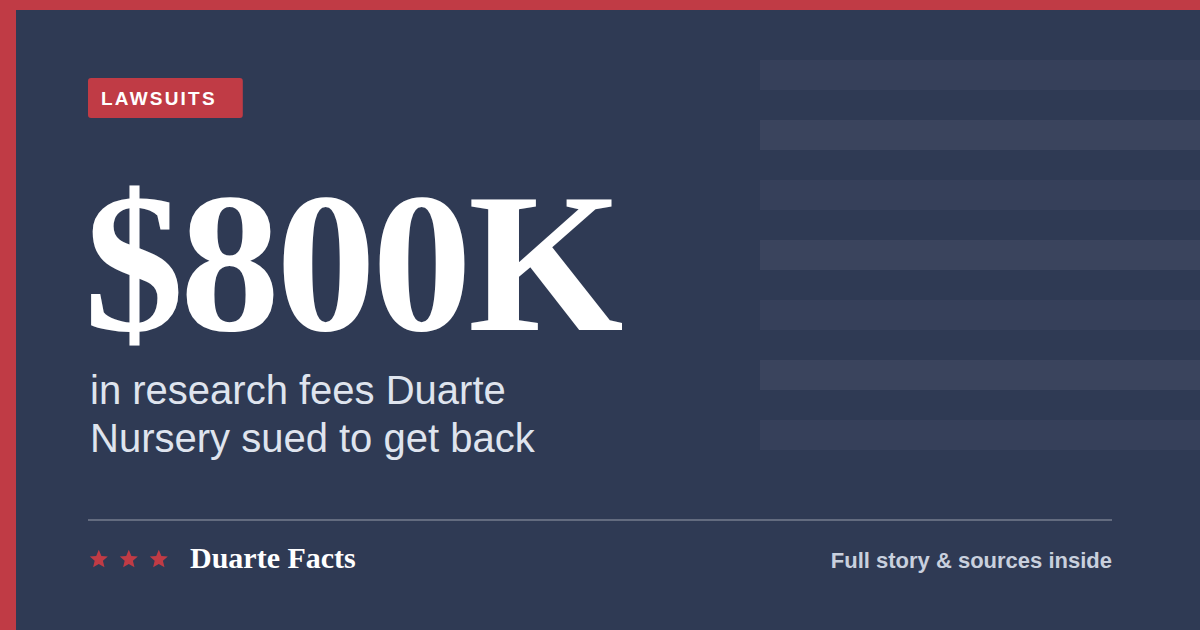
Duarte Nursery Sued to Get Back About $800,000 in State-Mandated Fees for Grapevine Research. A Court Called Its Appeal “Long on Innuendo and Short on Evidence.”
After a pest ravaged more than 50,000 acres of Napa and Sonoma vineyards, the Legislature made grape rootstock nurseries fund research on healthier rootstock. Duarte Nursery challenged the fee in federal and state court and lost both times.
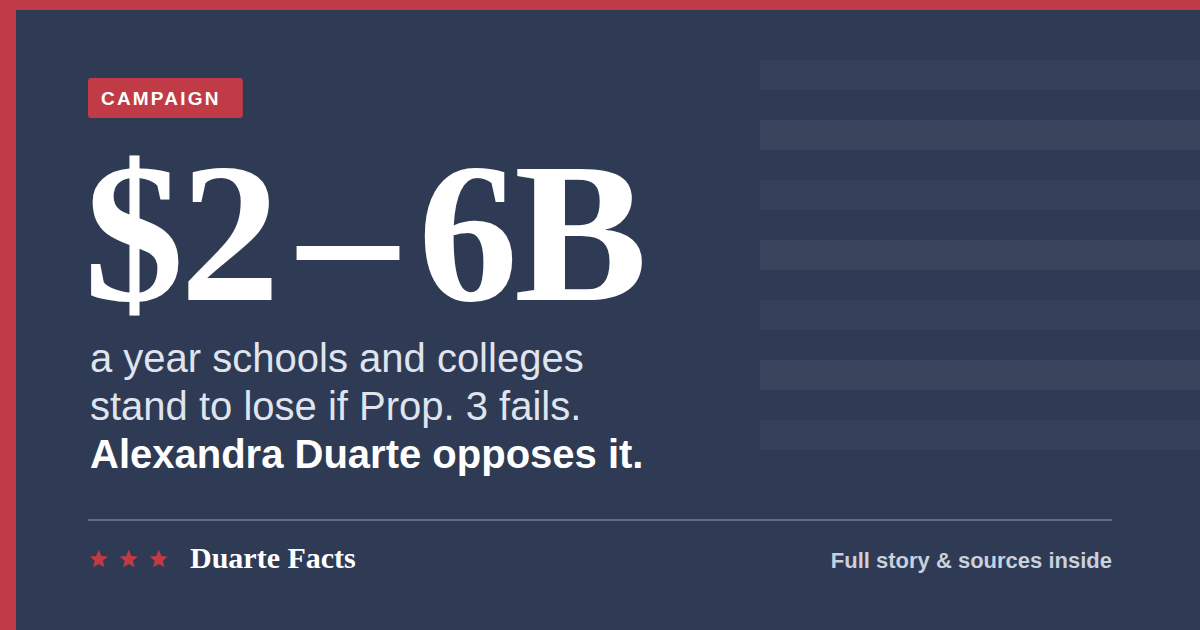
Alexandra Duarte Opposes Prop. 3. If It Fails, a Tax That Helps Pay for Special Education and Other School Programs Expires in 2031.
Prop. 3 would make permanent a 2012 income tax on the state’s highest earners. The Legislative Analyst says it brings in $5 billion to $15 billion a year, roughly 40% of it for schools and community colleges. Duarte calls it “another classic state tactic.”
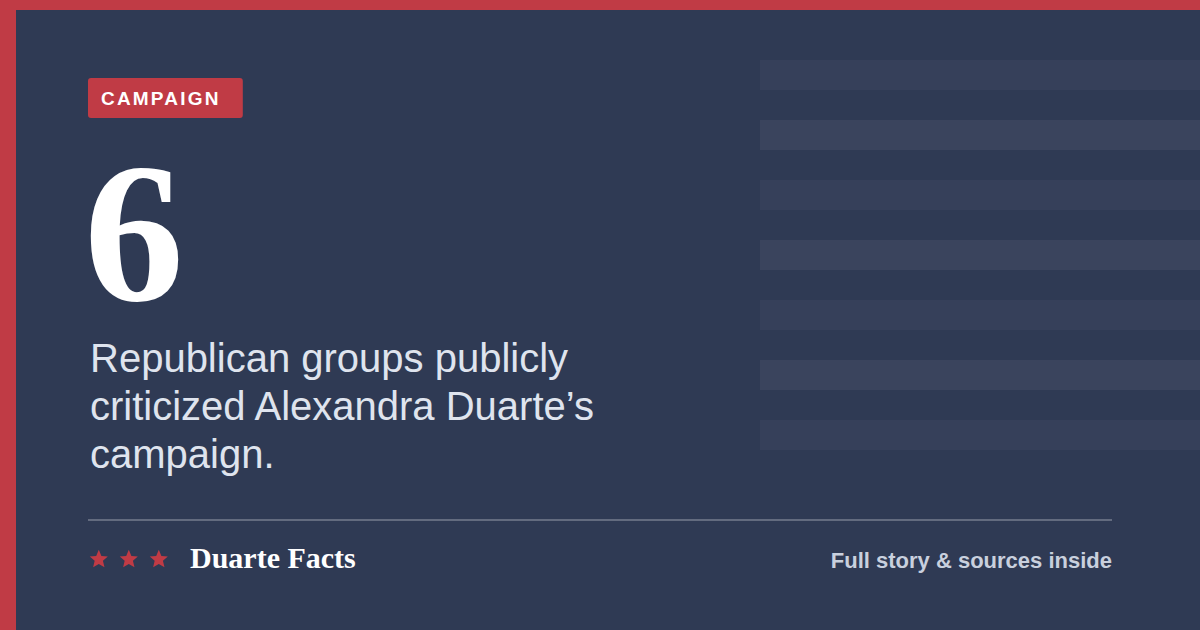
Republicans Condemned Alexandra Duarte’s Gun Mailer for “Troubling Imagery Implying Violence.” Her Other Mailers Called a Rival “Creepy” and Put Her Democratic Opponent in a Mugshot.
Before the June primary, the California Republican Party and five county and regional Republican groups criticized Duarte’s campaign. Her mailers attacked her Republican rival over transgender policy. Against Democrat Jaron Brandon, they use what one calls his “real mugshot.”